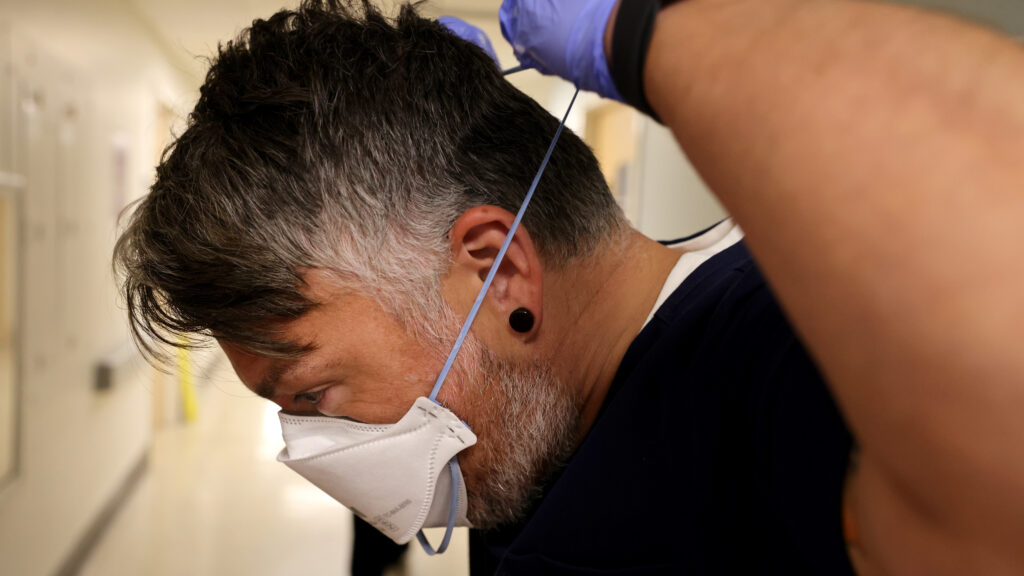
More men should go into nursing
While the number of Americans in need of care keeps rising, many health systems are struggling to find qualified nurses. The demand for qualified nurses is projected to increase nationwide, with nearly 200,000 annual job openings expected. This is driven, in part, by a mass exodus of nurses reaching retirement age. At this critical juncture facing our nation’s health systems, men remain an untapped group whose recruitment into nursing could make a difference.
Even with these persistent and growing nurse workforce shortages, men remain underrepresented in the profession, accounting for just 12% of nurses nationally. Concerted and sustained efforts are urgently needed to recruit more men to join the nursing profession and be positioned to provide high-quality, evidence-based care across communities nationwide.
Obtaining a nursing degree offers a vital job engine for many first-generation college students and an on-ramp toward the ever-fleeting American dream of financial stability. Careers in nursing hold the potential for job stability; competitive wages; upward mobility; leadership pathways; opportunities to work in fast-paced, technology-driven practice settings; and ultimately a variety of career trajectories
When I was applying to college, my parents, small business owners without college degrees themselves, offered practical advice shaped by what they were seeing around us. As unemployment rose and major employers closed down or downsized, many of my friends left our community as their families moved in search of jobs.
But our neighbors working in the local hospital or within family medicine practices remained steadily employed and grounded at a time of social and economic upheaval. It was within this landscape that I realized the stability and growth offered by pursuing careers in health care.
Even in today’s economy, nursing remains a stable and financially appealing option. Median salaries for registered nurses approach six figures and median salaries of graduate prepared nurses exceed $130,000.
Despite strong earning potential and an expanding job market, the proportion of men in the nursing workforce has largely remained stagnant in the past few years.
Research indicates that having men embedded in health care teams can enrich workplaces and patient experiences. A report from the National Academies of Sciences, Engineering, and Medicine argues that a more diverse nursing workforce, including gender diversity, strengthens the ability of health systems to deliver culturally competent, patient-centered care while simultaneously fostering trust and communication with patients from different backgrounds.
Increasing the number of men in nursing could benefit patients by strengthening care team dynamics. Gender-diverse teams have been shown to contribute positively to collaboration and interpersonal communication across professional settings, including in health care teams.
When clinicians and patients share the same gender, patients may be more comfortable, communicate more freely, and be more willing to engage in sensitive discussions or physical exams. In some care settings, male patients might engage in their care more with a male registered nurse or nurse practitioner.
Even with these financial benefits, patient care improvements, and contributions to team dynamics, the proportion of men entering nursing remains low, potentially due to barriers that limit participation or interests in the profession.
In my training at a top-ranked nursing program, I was one of only two men in a class of about 100 trainees. My male classmate and I often discussed how the profession’s financial stability drew us to nursing, but we also recognized the motivation to continue on with our nursing training was driven by opportunities working in fast-paced clinical environments and male leaders who encouraged us to pursue advanced nursing degrees.
Today, I serve as a nursing school faculty member, and I see little substantive growth in the number of men in nursing lecture halls. As an educator, I find this perplexing, considering that recruiting more men could help meet national calls to grow, bolster, and diversify the nursing workforce. Data indicate that male applicants tend to come from more racial and ethnically diverse backgrounds, and a greater proportion pursue graduate degrees than their female colleagues. The benefits of pursuing advanced nursing education among male applicants is evident by the growing number of men in leadership positions across health systems and academic settings. The nursing workforce will benefit from recruiting future highly qualified leaders, of all genders, whose diverse perspectives strengthen and advance the art and science of the profession for the betterment of patients.
The lack of male students across nursing schools signals a systemic workforce challenge and highlights an urgent need to scale up efforts to recruit and retain men in nursing practice, education, and research.
To close persistent gender gaps in nursing, leaders must invest in accessible funding for nurses’ education, expand outreach to men, and amplify men working in nursing as mentors to future applicants. Rising costs already limit access to higher education for many, and recent federal policies incorrectly classifying nursing as a nonprofessional degree will only further restrict access to financing for nursing school applicants. These changes to student loan borrowing are anticipated to reduce the nursing pipeline and further increase acuity in nursing shortages.
Institutions of higher learning need to invest time and resources into engaging men and boys in their local communities to apply to their nursing programs.
For example, each year my institution hosts a fellowship in nursing development (FIND) program that provides current college students from underrepresented backgrounds pursuing non-health-care majors a two-week immersive experience to learn about the nursing profession and diverse nursing roles in health care before applying to one of our nursing degree programs. The program complements recurring career workshops, led by my colleagues on the nursing school faculty offered within local high schools, community colleges, and historically Black colleges and universities in the Atlanta region. In these programs, nurse faculty members showcase the spectrum of careers available to underrepresented groups in nursing, including men. These efforts have helped expand the number of men enrolling across our school’s graduate nursing programs.
The historic gender gap in nursing has continued to propagate biases about what a nurse should look like. Many have traditionally mischaracterized nursing as feminine and subservient, but becoming an effective nurse in the modern health care landscape requires candidates to pursue complex and rigorous training. Far from its “pink-collar” stereotype, nursing is a technology-driven, high-skill profession that requires quick thinking and an advanced skillset to address the complexity of today’s patient care.
We must continue to highlight this side of nursing, including the men leading in care settings, conducting research, and changing health policy. This can be done through media campaigns by national organizations highlighting the work of men in nursing. While binging HBO’s latest season of “The Pitt,” I saw male actors portraying nurses and nurse practitioners seamlessly embedded on gender-diverse teams caring for high-acuity patients. Showcasing these narratives may help address outdated perceptions of the nurse workforce and aid in expanding the nurse applicant pipeline.
Additionally, nursing schools need to continue recruiting and positioning more male faculty to teach in prerequisite courses and engage with male students early on in their training. Health systems can strengthen the nursing workforce by working with academic practice partners in recruiting more men into graduate nursing programs, encouraging male employees in other allied health professions to consider pursuing nursing education, and creating opportunities for mentorship and leadership development among men in nursing. Strengthening and expanding pathways for men to enter nursing is vital to addressing workforce shortages.
My nursing journey was shaped by a supportive family and opportunity. Not all potential nurse applicants have these same resources I was fortunate enough to access. To make meaningful progress in increasing the number of men in nursing, we must sustain national efforts to widen access and ultimately turn the increasing tide of nursing shortages facing communities nationwide.
Nicholas A. Giordano, Ph.D., R.N., is a nurse and assistant professor at Emory University’s Nell Hodgson Woodruff School of Nursing in Atlanta. He is a fellow of the American Academy of Nursing, a former Hillman scholar in nursing innovation at the University of Pennsylvania, and Fulbright scholar.
STAT’s coverage of health challenges facing men and boys is supported by Rise Together, a donor advised fund sponsored and administered by National Philanthropic Trust and established by Richard Reeves, founding president of the American Institute for Boys and Men; and by the Boston Foundation. Our financial supporters are not involved in any decisions about our journalism.
PakarPBN
A Private Blog Network (PBN) is a collection of websites that are controlled by a single individual or organization and used primarily to build backlinks to a “money site” in order to influence its ranking in search engines such as Google. The core idea behind a PBN is based on the importance of backlinks in Google’s ranking algorithm. Since Google views backlinks as signals of authority and trust, some website owners attempt to artificially create these signals through a controlled network of sites.
In a typical PBN setup, the owner acquires expired or aged domains that already have existing authority, backlinks, and history. These domains are rebuilt with new content and hosted separately, often using different IP addresses, hosting providers, themes, and ownership details to make them appear unrelated. Within the content published on these sites, links are strategically placed that point to the main website the owner wants to rank higher. By doing this, the owner attempts to pass link equity (also known as “link juice”) from the PBN sites to the target website.
The purpose of a PBN is to give the impression that the target website is naturally earning links from multiple independent sources. If done effectively, this can temporarily improve keyword rankings, increase organic visibility, and drive more traffic from search results.