Transgender adults ensnared in youth gender-affirming care bans
SAVANNAH, Ga. — For Nikolas Indigo, the road to freedom was lined with warnings against a life of sin. Neither the road nor the message was a metaphor. Along nearly 250 miles of highway from Savannah to Atlanta, billboards preached: “turn from sin,” “Jesus is the way,” “repent.”
It’s a common pilgrimage for transgender people, who often need to travel for affirming procedures. Indigo, 25, made appointments with four different surgeons before he was finally able to get masculinizing chest surgery in Atlanta in September. Despite Savannah’s reputation for being young, hip, and at least a little queer, few local physicians perform the basic procedure.
Georgia is one of numerous states that have passed anti-transgender legislation in recent years, most of it directed toward minors. But adults, too, have struggled to get gender-affirming care here, and state restrictions on youth, Trump administration policies, and waning public support for queer communities are further jeopardizing that access as some clinics pull back on trans health care for all patients. With demand outpacing the availability of providers, wait times can stretch for months or even years, depending on the procedure, while insurance coverage is patchy and confusing.
“No matter how hard I tried, I could not do it on my own,” Indigo remembered about trying to find doctors for hormones and top surgery. It was the Savannah Pride Center, a nonprofit providing health and social services for the region’s LGBTQ+ community, where Indigo first found reliable information on affirming clinicians after fruitless internet searching and dead-end recommendations from a primary care doctor.
“The Southern mentality of, ‘I accept everybody, I love everybody, I just don’t want to get my hands dirty’ — that’s the general energy,” said Michael Bell, executive director of the Pride Center, and a father figure in Indigo’s found family. It was Bell, 43, who drove Indigo up to Atlanta for surgery. He wanted to protect him from the billboards. But the signs didn’t faze Indigo, who grew up in church country. So the pair made a game of it, laughing at the extreme language and aesthetics while singing tunes from the movie “The Greatest Showman.”
Indigo, who goes by his last name and is now a lead volunteer at the center, is the type of person with a positive outlook earned through formative hardships. “There’s something beautiful about going through trauma together,” he said of the political attacks on transgender people. He scoffs at the idea that these could possibly be the most trying times of his life. But he’s blunt about the challenges of accessing care in the U.S. right now, even when it’s legal.
“It’s not — oh, you have depression and you’re trans and those two things are a barrier. It’s that you have depression, you’re trans, and this administration wants to f—— kill you,” he said. Still, “I very firmly believe that this community can not just survive this, we can thrive through it.”
Central to his optimism is the Savannah Pride Center, which has been around under one name or another since 2017 and is currently the only LGBTQ+ center in Georgia. When Bell took over leadership of the organization in 2024, he could see there was a gap that needed to be filled. In two years, it has transformed from a social space to a full medical hub for the queer community. It offers free HIV testing and wellness checks, therapy from clinical psychology trainees, along with a monthly clinic that provides free checkups and trans-inclusive gynecological exams, low-cost STI testing, gender-affirming hormones, and other medications.
Serving around 4,000 people per year, the center sees a need to expand services as many health providers feel pressure to curtail care. But it’s been hard to garner funds and increase its reach. Bell hoped that the center’s second annual health summit, held in early March, would draw a crowd that was motivated to act against the Trump administration. Around 200 people attended the inaugural event last year. But this time, less than half as many people came.
Even with some financial and other support locally — at the summit, there was an entire table of state public health department employees — the center’s budget is shoestring. Clinicians, including the nurse practitioner who comes in for the monthly clinic, donate their time, making it difficult to increase offerings.
When Bell started, he was able to bring in funding from Gilead Sciences, as he had worked with the company before. Last fall, however, Bell said that Gilead decided not to renew a donation of more than $30,000. “We value our long-standing relationship with the Savannah Pride Center and the important work they do,” Gilead said in a statement, which also noted that the company is a leading funder of HIV philanthropy in the U.S.
Until Trump’s term is over, “the strategy is to play it safe,” Bell said. “For the next couple years, let’s do as much as we can to build out without adding to the amount of expenses we’re accruing every month.”

The gap between reputation and reality
Savannah has long been a city “where your eccentric uncle goes,” as one such character who attended the center’s health conference phrased it. Nestled along Georgia’s marshy coastline, “the Hostess City of the South” has a reputation for inclusivity among queer people.
“It was being gay that brought me down here,” Patty Latham, who moved from Augusta in 1984 and co-founded a historic LGBTQ+ group, said nearly 40 years later in an interview for the city’s oral history project. First City Network aimed to educate the community about AIDS, but with more of a nonconfrontational, Southern approach than national activist groups like ACT UP took. “We just were educating people and doing some community outreach,” she remembered. “We wanted to do it with ease, rather than in your face.”
Like in any city, a queer scene existed along the margins with intermittent support from local leaders. But in 1994, the novel “Midnight in the Garden of Good and Evil” thrust Savannah’s queer community onto the national stage. The story, based on the real-life killing of a male sex worker, was a New York Times bestseller for more than four years, and turned locals like The Lady Chablis, a trans nightlife performer, into legends. In the years after the book’s publication, the city’s reputation as a gay harbor flourished.
Today, one facet of the vast footprint that the Savannah College of Art and Design leaves on the city is the annual importation of young queer people. (A 2011 student blog post describes the student body as “mostly female … and a sizable amount of homosexual male students.”)
“People come from four hours away in every direction but the ocean,” Bell said of the Pride Center’s clientele. Just 12% of Georgia residents — mostly those in Atlanta and Savannah — are protected by gender identity or sexual orientation nondiscrimination ordinances. Still, the state is often seen as the lesser of two evils when compared to a neighbor like Florida. With about a quarter of the population of Atlanta, Savannah appeals to those arriving from rural areas.
Bell has a northerner’s appreciation of the city, wearing shorts and T-shirts year-round and making light of the so-called traffic jams. He revels in the romance of the low blanket of mist that appears each morning and the way you can see the stars at night from the historic district’s unlit streets. But two years at the Pride Center have also acquainted him with the gap between the city’s reputation and reality.
“We’re purple, but it’s very red in that gold dome,” Aisha Gray, an organizer at Georgia Equality, said at the health summit, referring to the state capitol building in Atlanta. In Savannah’s Forsyth Park, a large Civil War memorial “to the Confederate dead” takes center stage.
That dissonance seeps into every aspect of life, even in a place considered a refuge for LGBTQ+ people. Georgia hopped on the bandwagon to ban gender-affirming care for minors relatively early, in 2023, though the state continued to allow the use of puberty blockers. This year, a bill was filed that would ban those, too.
Ben Watson, the physician senator from Savannah who introduced the measure, noted that it would not restrict care for trans adults. “If you’re an adult and you choose to do that, then that is on you,” he said. Lawmakers also considered legislation that would ban the state employee health insurance plan from covering gender-affirming care for adults and their dependents. Neither bill passed by the end of the legislative session, but like many states, Georgia restricts transgender people’s ability to change their gender marker on driver’s licenses and birth certificates. That’s the next hurdle for Indigo — in Georgia, both proof of surgery and a court order are required to change a birth certificate, and one of those three documents is required to change a license.
“It’s that statement of, ‘Yeah, sure, I support anybody.’ But there’s no ground for that statement to actually stand on,” Indigo said.

Deadnamed by a surgeon, shut out by a hospital
The first time that Indigo had a consultation for top surgery, he did it in secret. His roommates at the time were judgmental about his motivations, but he’d wanted top surgery for as long as he could remember, even before he knew what it was. As a teen raised in a Christian fundamentalist household in Florida, he prayed to God that his breasts would disappear, and if not, then for breast cancer. At 22, he left home to begin building a new life and forming a new family in Savannah.
Indigo is always nervous for doctor’s appointments, but this time, he was terrified. He hadn’t started taking testosterone yet, and knew people might perceive him as a girl. At the appointment, the doctor repeatedly deadnamed him. “I did not like the vibe of that man, zero out of 10,” Indigo said.
The next surgeon was more promising. “Every trans person that I know in Savannah has gone to him,” Indigo said. The doctor, a plastic surgeon, often operates at an outpatient surgical center, but only accepts insurance for gender-affirming procedures performed at a local hospital, Memorial Health. Soon after Trump issued his executive orders on gender and pediatric trans care, Indigo said he received a call from the surgeon’s office that Memorial was cancelling top surgeries. He could still get the procedure at an outpatient center, but it wouldn’t be covered.
He was staffing the front desk at the Pride Center when he got the call. “I hung up and I cried,” he said.
In a statement, Memorial Health said that it has never had a gender-affirming surgical program, and that the hospital follows the law regarding age limitations on affirming procedures. “Beyond that, we do not interfere with physician and patient decisions,” the statement read.
Georgia is one of 26 states where Medicaid explicitly covers transgender health care, but the trans resource site TopSurgery.net estimates that just one outpatient surgical center and one hospital in the state currently accept any insurance for affirming surgery.
With no local options, Indigo started looking in Atlanta. He scheduled one consultation that was canceled a week beforehand because the doctor wouldn’t take his insurance. Then, a fourth surgeon, another consultation. After the appointment, Indigo waited three months for his letters of support — documentation from mental health providers often required to receive gender-affirming surgery and have it covered — to be reviewed and for insurance to confirm it would cover the procedure. He didn’t hear anything in that time and started feeling desperate.
“I’m not going to start an OnlyFans for feet, that’s not going to be profitable,” he remembered telling himself. He didn’t have to. The surgery was scheduled, and he stayed with a friend in Atlanta during the initial recovery. In the days after the procedure, he was filled with joy, always tearful.
“I feel so, so, so, so, so free,” he wrote in his journal soon after the procedure. “I have read so many horror stories, and honestly, was prepared for the worst. I was not prepared for the amount of joy I feel. The amount of love I feel for myself is insane, it’s overwhelming.”
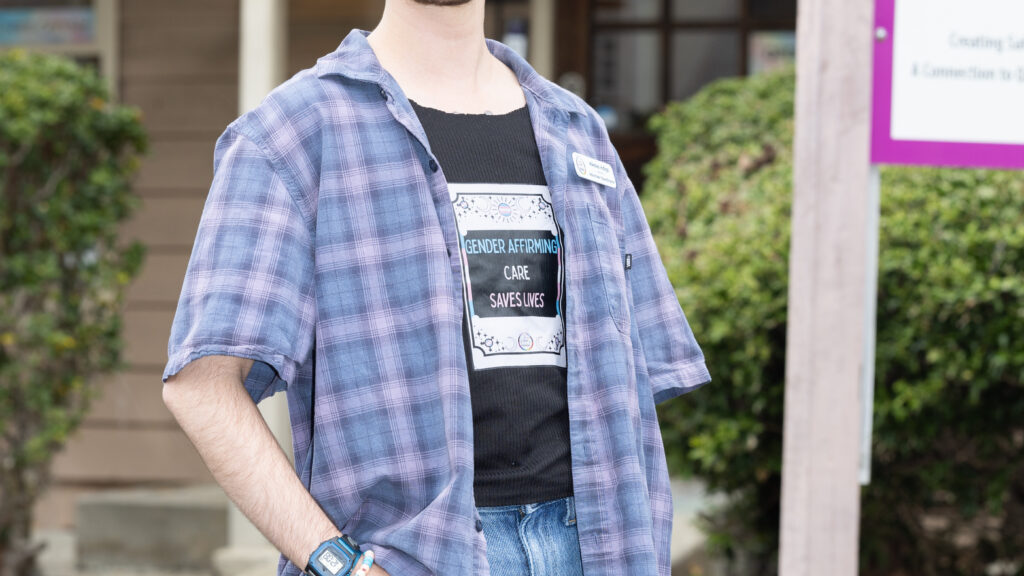
You couldn’t tell now that he grew up in such an insulated environment — one that he refers to as a cult. He lived at home during college, where he nearly majored in Christian songwriting, wearing big fancy dresses to performances. These days, he looks a lot like his Gen Z peers across the country. The day before the health summit, he wore black, baggy jeans and a Pride Center T-shirt with the neck sliced open. He watches the “Wicked” movie musicals and paints in his spare time, and cuts his own hair, expertly, with tight, often colored curls atop his head, a close shave on the sides. That night, he cut a shaggy mullet for another center volunteer.
For Indigo, the Pride Center is so much more than a community center or health hub. It’s been his anchor, helping him make connections and find work in his new home. Indigo has autism, and will soon get an evaluation for ADHD — even walking outside, where the sound of the world is turned up too high, can lead to sensory overload, so he quickly slips a large pair of noise-cancelling headphones over his ears. (On the day of the summit, he opted for more discreet earplugs, conscious of how he might be perceived.)
Thanks to a job placement partnership that the Pride Center has with Kroger, Indigo landed a day job at the grocery store chain. He’d love to work — really work, as a paid employee — at the center, but it likely isn’t in the budget anytime soon. Still, Bell has tried to make unofficial job training part of volunteering. Indigo recently got Pride Center business cards.
This spring, he joined the city’s LGBTQ+ task force, another volunteer position. “That has been” — there’s a long pause — “interesting,” Indigo said. So far, he’s found it frustrating to walk politicians who are much older than him through each tiny detail of the barriers queer people face, and how both local and national policies have a real impact.
“I live with this hopeful delusion that everything’s going to be fine, and I can make it fine,” he said. Despite feeling like a superhero growing in strength every time he takes his testosterone, “I’m slowly starting to realize I do have limits.”
At a community forum last year, Indigo hit one of those limits. A gay Pride Center volunteer named Chris had recently been shot dead at a dollar store. Police said there was no evidence of a hate crime, but advocates countered that the city doesn’t accurately track such offenses. The Savannah police department hasn’t reported a hate crime to the FBI since before 1991 and, in 2021, stopped reporting crime statistics to the federal agency altogether. After the city’s mayor reiterated a claim that there simply are no hate crimes in Savannah, Indigo confronted him with a question about Chris. The mayor walked out, leaving Indigo fuming.
Afterward, “I go home and I paint something that would not be great if it saw the light of day,” as Indigo puts it: Harsh words that he knew — and Bell reminded him — he shouldn’t post online. Eventually, he recalled meditation sessions at the center. “Release what no longer serves you. You take a deep breath and it goes away,” he said. He painted over the angry text with that message. Later, at a fundraiser for the center, the painting sold for $200.

Dishing out advice, Plan B, and friendship
The day before the health summit, Bell, Indigo, and the center’s program director, Jessica Saunders, gathered around a half-assembled photo backdrop, stumped by its mechanics. Before they figured it out, the main Pride Center phone, a cell, rang from Indigo’s pocket. He quickly relayed the caller’s request to Saunders: Somewhere to get an HIV test today? Without pausing a moment to flip through her mind’s Rolodex, Saunders offered: The county health center on Drayton takes walk-ins until 4:30.
These small inquiries pepper the day. Over lunch, a parent called looking for ideas of “things to do” for their 19-year-old. Later in the afternoon, somebody called looking for Plan B. There were only two doses of the emergency contraceptive left in the building, and Saunders decided to give the caller both. When they arrived, Indigo presented a discreet gift bag that also included two pregnancy tests and a grocery gift card. He and Saunders explained the directions on the box: If you throw up after taking it, you may need a second dose, but call a doctor first.
It’s a scrappy operation. Neither Saunders nor Indigo remembered exactly how they got the Plan B; nor did they know how they would get more.
With Saunders and Bell the only paid staff members, all of the center’s day-to-day work falls to them and a cadre of about five core volunteers. On a usual day, that means answering the phone, taking out the trash, and checking in clients. It can also mean simply sitting and spending time with people who wander in, looking to talk.
The Pride Center building sits like a cozy cottage inside of an office park, tucked away from the main road, south of the city’s more bustling, walkable historic district. Here, cars reign, and Indigo doesn’t have one. When he volunteers on Thursdays, Bell often picks him up and drops him at home afterward. (A big part of Bell’s fatherly role involves drop-offs and pickups for volunteers at work, medical appointments, and the center.)
The vibe inside is “professional gay,” as Indigo calls it, with low lamp lighting and fuzzy pillows in the informal waiting room. A “self-care jar” sits on the mantle, from which visitors can take small note cards with affirmations. The walls are lined with art made by volunteers including Indigo; the furniture was mostly donated.
A lean organization can also be a flexible one. Last spring, the Trump administration announced that the biggest source of federal homelessness grants could not be used to promote “gender ideology.” That’s left shelters across Georgia at risk of losing funds if a trans person is given a bed that doesn’t align with the president’s idea of their gender.
Two local leaders saw a workaround: the Pride Center. They wrote up a memorandum of understanding — a formal gentleman’s agreement — to give the center $10,000 to offer, as needed, a few nights in a hotel to trans or gender-expansive people experiencing homelessness. It’s not a permanent solution, but will hopefully serve as a chance to shower, sleep, eat, and then figure out their next steps, according to Stephanie Kaple, leader of the Savannah Chatham County Interagency Council on Homelessness, who spoke at the summit.
Bell has formed close, working relationships like this with public health leaders across the county and state. Bonzo Reddick, health director for Georgia’s coastal district, often refers people to the Pride Center’s “insanely cheap” counseling services, he said at the summit. In turn, Bell refers people to the county for its discounted supply of PrEP, the HIV prevention therapy.
Like Indigo, Bell moved to Savannah to start over. His father had passed away, and he needed to separate himself from the rest of his family and his previous life. He and his husband arrived with few possessions: books, some art, a bed, the dog. He sees the parallels between his own journey and Indigo’s.
“There is that connection there of understanding that. Everyone knows what it’s like to feel alone,” Bell said. He’s been cautious about forming close bonds with volunteers, not wanting to overstep. But the community at the center has become his own found family. Indigo and a few other volunteers have begun to spend holidays at Bell’s home.
“That really took me by surprise,” Bell said. “A beautiful, nice, wonderful surprise.”
STAT’s coverage of health inequities is supported by a grant from the Commonwealth Fund. Our financial supporters are not involved in any decisions about our journalism.
PakarPBN
A Private Blog Network (PBN) is a collection of websites that are controlled by a single individual or organization and used primarily to build backlinks to a “money site” in order to influence its ranking in search engines such as Google. The core idea behind a PBN is based on the importance of backlinks in Google’s ranking algorithm. Since Google views backlinks as signals of authority and trust, some website owners attempt to artificially create these signals through a controlled network of sites.
In a typical PBN setup, the owner acquires expired or aged domains that already have existing authority, backlinks, and history. These domains are rebuilt with new content and hosted separately, often using different IP addresses, hosting providers, themes, and ownership details to make them appear unrelated. Within the content published on these sites, links are strategically placed that point to the main website the owner wants to rank higher. By doing this, the owner attempts to pass link equity (also known as “link juice”) from the PBN sites to the target website.
The purpose of a PBN is to give the impression that the target website is naturally earning links from multiple independent sources. If done effectively, this can temporarily improve keyword rankings, increase organic visibility, and drive more traffic from search results.