With science funding at risk, an advocate sees ‘light at the end of the tunnel’
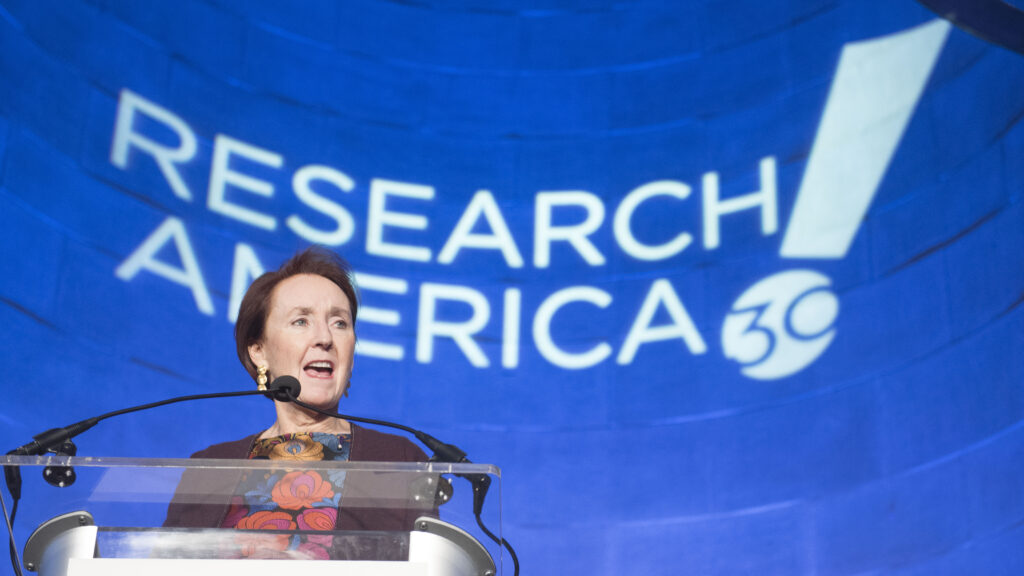
For most of Mary Woolley’s career, science and politics have existed harmoniously. On only a few occasions have they become misaligned, said Woolley, who has served as president and CEO of the research advocacy group Research!America since 1990.
Those occasions include a movement to slash the budget of the National Institutes of Health in the mid-1990s, a wave of skepticism of science during the Covid-19 pandemic, and the Trump administration’s current slashing of research funding.
“In this particular Congress and this administration, there has been vilification of some parts of science,” Woolley said. “Science meets politics has really been elevated around issues that have nothing to do with making people healthier and more secure — but have more to do with, ‘If I’m for it, then you’re going to be against it. If I’m a Republican and for something, then you’re a Democrat and you’re going to be against it, no matter what it is’ and vice versa. That kind of political battling is not good for anyone.”
“Science is there to advance the public’s goals,” she added.
Science advocates say the Trump administration’s proposed cuts for next year would be catastrophic, but there are some early signs that Congress might rebuff them. Two weeks ago, a Senate committee endorsed a $400 million increase to the NIH budget and rejected the administration’s proposal to consolidate the agency’s 27 institutes and centers into just eight.
Woolley, who recently announced that she will step down from her role in early 2026, spoke with STAT about her time at Research!America, the current state of federal research funding, and her views on how science and politics can benefit one another. This conversation has been edited for length and clarity.
How did you get involved in advocacy for research?
I studied both sociology and political science. I was very politically engaged, and I thought I was going to go to law school and then go into public service with that degree — go work in Washington, work for one of the agencies. I was a great believer in government. I still am, and trying to make it as effective as possible. But I got sidetracked on that for a couple of reasons, including being very active during demonstrations around the Vietnam War. I became kind of disillusioned with government and politics.
I decided that I would take some time away from that career trajectory, and I got a master’s degree in the humanities. That was a wonderful experience. And at the end of it, I had even less idea what I was going to do. I needed a job, and that’s when I took a job in a medical center. Because of some family and close friend illnesses — and in one case, death — I realized, wow, I could really make a difference in the political side of research by persuading more people that research was a value that they could relate to and support through their tax dollars, through their consumer dollars, and through their philanthropic dollars.
By the middle ’80s in San Francisco, AIDS was a horrifying epidemic. It was terrifying, terrifying to everyone. I mean, everyone. And in my institute, we were doing some of the state-of-the-art, if you will, work on the virus. And it felt good to be part of this solution at the same time that we were horrified at the problem.
What was the biggest lesson you learned leading Research!America?
Politics runs in a different way than science does. No matter what party is in power in Washington at any given time and what is going on, money is going to be allocated, appropriated, and money will be spent. It’s going to happen even if the scientist or the university or the industry person wishes it were done differently. You can’t ignore it.
And understanding how the political process works is essential. So it often works with incomplete information. You don’t have all the answers to everything you wish you had before you made a decision. Whereas scientists work differently. They work with not making a decision until they do have all the information. And if they skip some things, their results will be off. The paper won’t be accepted. They’re going to be set back. They might not get their next grant. The list goes on. You can’t skip any steps in science.
Understanding that is important for scientists to comprehend why the political actors don’t necessarily think the same way they do. They’re thinking about different things. All of us want better health, we want security, we want prosperity for the nation and for ourselves and our families. How you get there is the politician’s job. It’s up to scientists to figure out where they fit in that equation and not get into arguments or tradeoffs that are not real in the minds of an average American.
Research!America helped double the budget of the NIH in the late 1990s and early 2000s, something especially significant given the current federal funding landscape. Can you discuss how the organization achieved this?
It was a political process. In the early ’90s, a group of scientists wrote an article in Science magazine that made the case that NIH research could be even more effective if it had double the dollars. The pace of scientific discovery at that time was so incredible. It was pretty clear to the science community that there was going to be more and more progress. But the science had to be conducted.
We took that and started testing it in the political world — first, by commissioning surveys in various parts of the country to say, “Do you think there should be more or less or the same amount of medical research conducted?” Almost without exception, people wanted more research. We could see that it wasn’t going to be a tough sell to the public to double the NIH budget.
We turned to trying to convince members of Congress to not only say it, but believe it and own it. There were actually several members who were ready to go do that. They could really see the benefit to their constituents and to the U.S. reputation in developing the future of science and scientists. That started working its way through Congress. In the mid-to-late ’90s, the push was really making the rounds via a separate group that Research!America set up called the Campaign for Medical Research. It called on former major leaders in Congress to go around to their former compatriots and colleagues and make the case. They did that as volunteers, which was pretty incredible.
And in advertising and letter writing, we were putting as much attention as possible on doubling the budget. A part of the advocacy community, a type one diabetes group, persuaded then President George W. Bush to support doubling in five years. He came out publicly and said that when he was running for the presidency. And he kept his word.
How do you think science and politics can be reconciled in today’s political environment?
Being at the nexus of science and politics and policy is critically important, and it’s really what I’ve spent my career doing.
We just had an experience over the last few months — which culminated in success — of how to work with what is a very bad situation and turn it over. The president’s budget for this upcoming year included massive cuts to the National Institutes of Health, the National Science Foundation, the CDC, and the list went on.
The advocacy community, and we are a major part of that, got to work on convincing members of Congress that this would compromise health, and it would compromise our global leadership status. Repeatedly, more and more people were saying to their own senators, “You can’t do this. You can’t make these cuts. You will collapse progress in health. Is that really what you want to happen on your watch, senator?”
Last week, the relevant Senate committee said, “We’re going to add money.” That finally got turned around through an extraordinary campaign. Advocacy does work.
What are your thoughts on stepping down from your role at Research!America?
We’re in one of those crucible moments now, and we’ve already seen light at the end of the tunnel in that story of the Senate Committee. And there’ll be more, but it doesn’t happen by itself.
As a mentor of mine used to say, “You can’t sit on your hands.” You can change the image of what’s to come, but you can’t do it sitting on your hands. You also should always have hope, but realize that hope is not a plan. You have to be active and vocal. Research!America will continue to be those things, and I’ll never lose the passion for the mission.
medical
Pendidikan
Pendidikan
Download Anime
Berita Teknologi
Seputar Teknologi